
Author name: Jan Sierpe

Real-Time Visibility Transforms Manufacturing Leadership

The Strategic View – Part 3 How Visibility Transforms Leadership and Compounds Over Time

Real-time visibility fundamentally changes how manufacturing facilities operate. Executives gain evidence-based insights for capital and capacity decisions. Supervisors evolve from controllers to coaches. Problems that once recurred get solved permanently. The pattern is consistent: faster firefighting leads to fewer fires, then a culture where constant crisis disappears.

The Strategic View – Part 3 How Visibility Transforms Leadership and Compounds Over Time Read More »


Real-Time Visibility Transforms Operator Problem-Solving

From Escalation to Resolution – Part 2: When Problem-Solving Becomes Part of the Process

When operators gain real-time visibility into production performance, problem-solving shifts from escalation to resolution within the workflow. Clinical precision in data eliminates the traditional speed-accuracy trade-off, enabling faster decisions without sacrificing quality. Problems become visible before they become crises—transforming reactive operations into proactive excellence.

From Escalation to Resolution – Part 2: When Problem-Solving Becomes Part of the Process Read More »

From Firefighting to Foresight: Real-Time Manufacturing Data

From Firefighting to Foresight – Part 1 How Real-Time Visibility Transforms Daily Operations

Manufacturing’s daily firefighting rhythm—scrambling, stopping, fixing—feels inevitable but isn’t. Real-time visibility through SpencerMetrics CONNECT replaces reactive crisis management with clinical data precision. When everyone sees the same timestamped, correlated information simultaneously, thirty-minute problem-solving meetings become thirty-second interactions or disappear entirely.

From Firefighting to Foresight – Part 1 How Real-Time Visibility Transforms Daily Operations Read More »

Production Intelligence: Building Advantage That Compounds

Building Competitive Advantage That Compounds: The SpencerMetrics Effect (Part 3 of 3)

Real-time production intelligence delivers more than immediate productivity gains. As data accumulates and workers internalize data-driven decisions, competitive advantages compound over time. Competitors can buy similar technology, but they can’t replicate years of accumulated data, developed organizational capabilities, and established culture.

Building Competitive Advantage That Compounds: The SpencerMetrics Effect (Part 3 of 3) Read More »

How Real-Time Data Ends Production Guesswork for Managers

From Guesswork to Clinical Precision: The SpencerMetrics Effect (Part 2 of 3)

Production managers often operate as historians of failure—investigating yesterday’s problems instead of preventing tomorrow’s. SpencerMetrics CONNECT changes this dynamic with real-time granular data, intelligent pattern recognition, and predictive alerts. Decision timelines compress from weeks to minutes, transforming reactive firefighting into proactive optimization across single or multiple facilities.

From Guesswork to Clinical Precision: The SpencerMetrics Effect (Part 2 of 3) Read More »

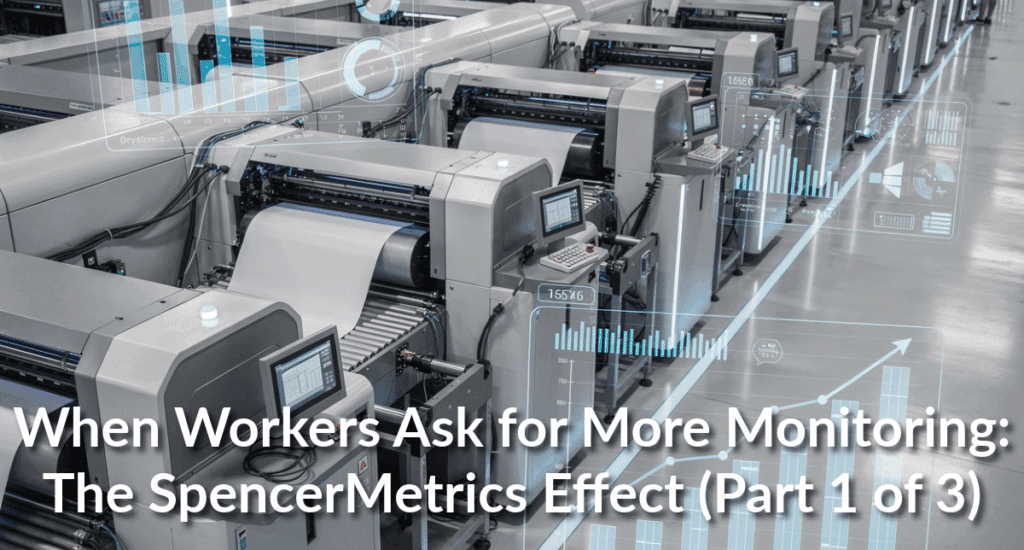
Header Image: Something unexpected is happening in manufacturing: workers are requesting more monitoring. SpencerMetrics CONNECT transforms production data from retrospective judgment into real-time support. When operators control their own performance metrics, they feel equipped rather than watched—driving sustainable improvements that originate from the floor, not management mandates.

When Workers Ask for More Monitoring: The SpencerMetrics Effect (Part 1 of 3)

Something unexpected is happening in manufacturing: workers are requesting more monitoring. SpencerMetrics CONNECT transforms production data from retrospective judgment into real-time support. When operators control their own performance metrics, they feel equipped rather than watched—driving sustainable improvements that originate from the floor, not management mandates.

When Workers Ask for More Monitoring: The SpencerMetrics Effect (Part 1 of 3) Read More »