
By Jan Sierpe
Something unusual is happening on factory floors across the country. Production workers are asking for more monitoring. Not grudgingly accepting it—actively requesting it.
If you’ve spent any time in manufacturing, you know this shouldn’t happen. Monitoring systems typically face resistance. Workers view them as surveillance. Managers struggle with adoption. Yet SpencerMetrics’ CONNECT® system creates the opposite reaction: operators who become advocates, requesting expanded capabilities across their lines.
This three-part series explores why. We’ll look at what happens when production intelligence aligns with human psychology (this piece), how it transforms day-to-day management operations (Part 2), and what implementation actually looks like in real facilities (Part 3).
The short answer? When you give workers tools that help them rather than judge them, everything changes.
What Actually Drives the Response
The difference isn’t in the sensors or the data processing speed. It’s in what workers see and when they see it.
CONNECT doesn’t tell operators what they did wrong yesterday. It shows them what’s happening right now and helps them understand it. That shift—from retrospective judgment to real-time support—changes the entire relationship with performance data.
Think of it as the difference between a teacher reviewing your test after class versus a tutor helping you work through problems in real-time. Same information, completely different experience.
Four Changes That Matter
When workers control their own performance data, their behavior shifts in predictable ways:
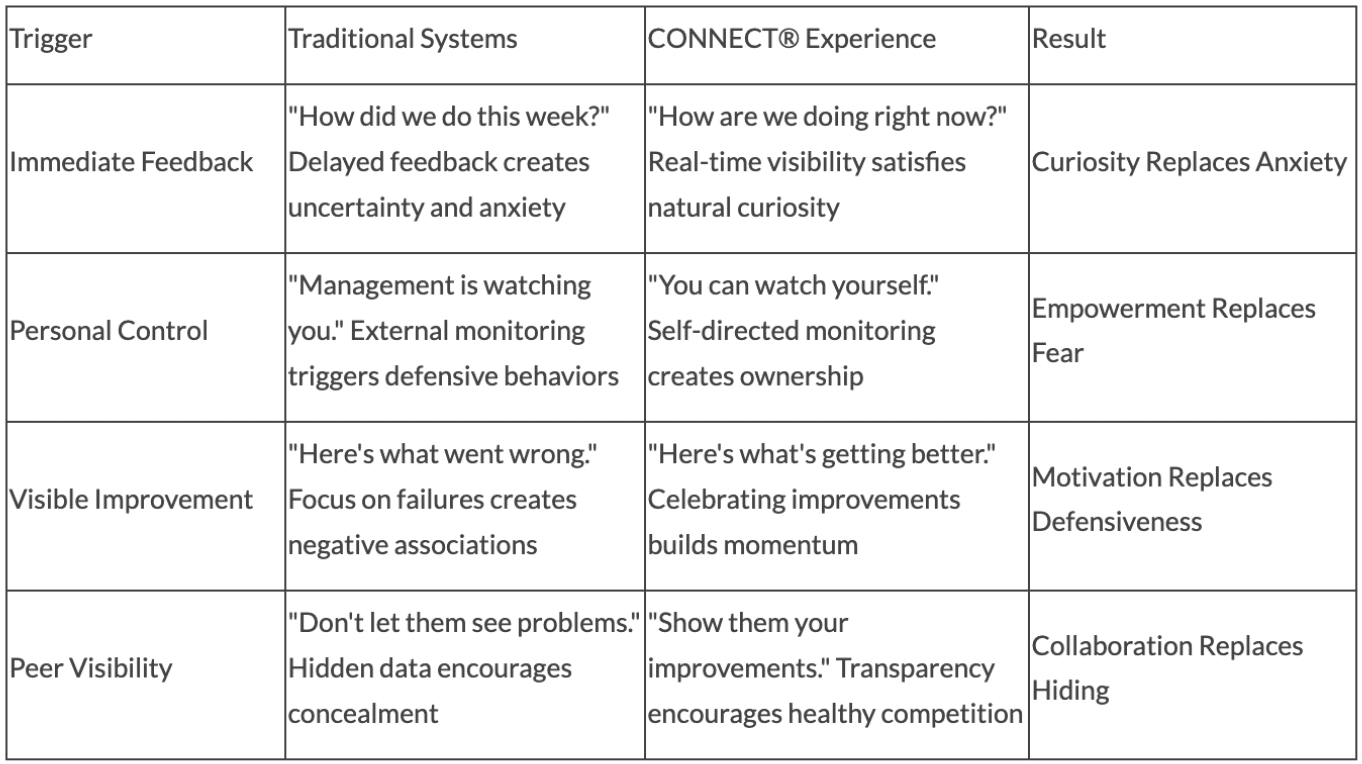
- Instead of waiting for weekly reports, they check current performance. Real-time visibility satisfies natural curiosity. People want to know how they’re doing—not next week, but now.
- Instead of feeling watched, they feel equipped. When you can track your own metrics instead of having someone else track them for you, monitoring becomes empowerment.
- Instead of hearing about problems, they see improvements. The system highlights what’s getting better, not just what went wrong. That positive framing builds momentum.
- Instead of hiding issues, they share solutions. When performance data becomes visible to peers, it creates healthy competition rather than defensive behavior. Workers start swapping tips instead of covering problems.
These aren’t minor adjustments. They represent a fundamental shift in how production floors operate.
Making It Work Across Generations
Manufacturing facilities today employ four distinct generations, each with different relationships to technology:
- Baby Boomers often approach new systems with skepticism—they’ve seen plenty of “solutions” that complicated their work without making it better. CONNECT works for them because it validates their expertise rather than suggesting their experience needs replacement. The data confirms what they already know from years on the floor, while revealing patterns they couldn’t see before.
- Generation X values practical tools that actually reduce workload. They’re tired of systems that promise efficiency but deliver extra administrative tasks. CONNECT delivers on the practical promise—real information, less guesswork, fewer firefights.
- Millennials expect transparency and continuous improvement from their workplace technology. They grew up with feedback loops and performance metrics. CONNECT provides exactly that expectation, making manufacturing feel more aligned with modern work environments.
- Generation Z, true digital natives, evaluate interfaces instantly. If it’s clunky or counterintuitive, they’ll work around it. CONNECT’s design meets their standards for digital tools—clean, fast, obvious.
The system works across these generations because it addresses a universal truth: skilled professionals want to excel at their work. Give them clear information about their performance, and they’ll use it.
How Information Actually Moves
Traditional manufacturing structures information flow through layers:
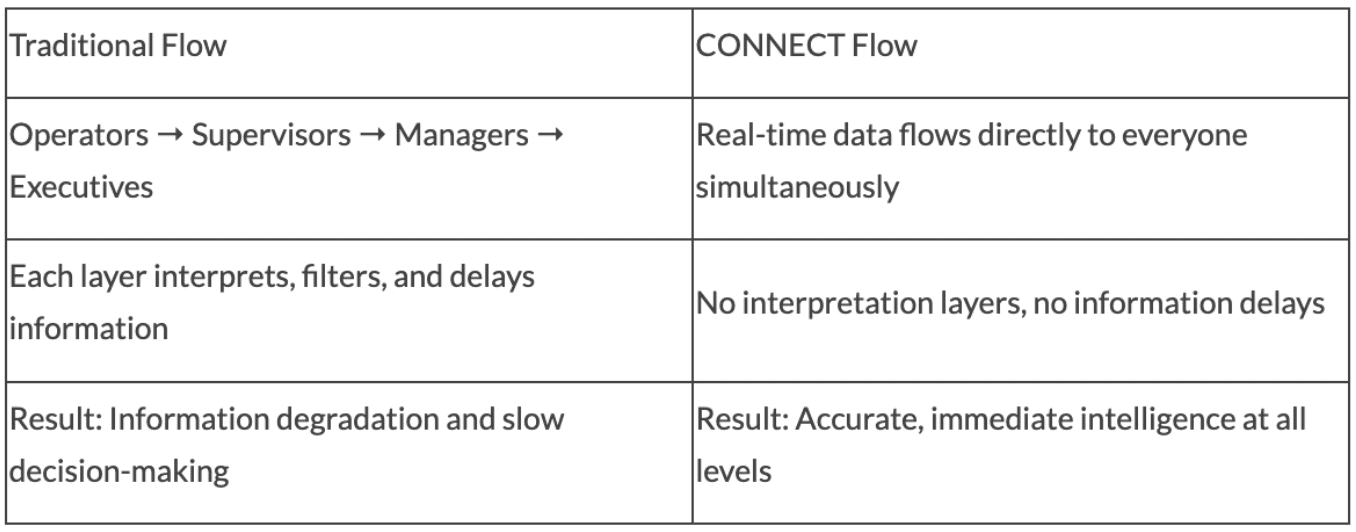
Operators observe something → report to supervisors → who update managers → who inform executives
Each handoff introduces interpretation, filtering, and delay. By the time information reaches decision-makers, it’s been processed through multiple perspectives, stripped of nuance, and aged into history.
CONNECT removes those layers. Real-time data flows simultaneously to everyone who needs it. The operator sees the same metrics as the plant manager simultaneously. No telephone game. No waiting for shift reports.
This creates something manufacturing facilities don’t typically have: a shared operational reality. Everyone’s working from the same information at the same time.
Client Examples: What This Actually Looks Like
- 4Over, moved from estimating production to knowing it. That sounds simple, but the impact is significant—decisions about productivity and equipment use became proactive rather than reactive.
- Colorfx Inc. achieved an 8% productivity improvement through their management portal. The key was to provide managers with summarized views that allowed them to drill into details when needed—the right information density for each role.
- Copy General saw 5% productivity improvement through detailed, real-time reporting. Nothing else changed—same equipment, same workforce. Just better visibility into what was actually happening.
- Lakeside Book Company significantly enhanced their digital manufacturing operations, with management noting that SpencerMetrics had been “instrumental in improving our operations through real-time data visibility.”
- Numo Manufacturing started with one area, saw results, and expanded across additional company operations. That pattern—initial success leading to organic expansion—repeats across implementations.
- Marathon Press implemented automated production tracking, reducing costly reprints and providing real-time job status. Less waste, better information flow.
These aren’t dramatic transformations. They’re steady improvements from better visibility—5% here, 8% there, fewer errors, faster decisions.
What Makes This Sustainable
Here’s what separates temporary improvements from lasting change: the source of the momentum.
Traditional improvement initiatives start with management mandates. Consultants arrive, changes are implemented, initial enthusiasm appears, and then it gradually erodes. Within months, people revert to familiar patterns.
CONNECT works differently because the improvement initiatives originate from the workers themselves. They’re not being told to improve; they’re discovering opportunities and pursuing them because they can now see them.
When a press operator notices that their morning efficiency is consistently 3% higher than their afternoon efficiency, they begin to investigate why. It could be the temperature. It could be material batch variations. It could be something nobody would have thought to look for. The point is, they’re looking because the data makes them curious, not because management assigned them a project.
That curiosity is self-sustaining. It doesn’t need reinforcement from leadership. It just needs the tools to satisfy itself.
The Typical Adoption Pattern
Based on client implementations, the progression is remarkably consistent:
- Week 1: Cautious exploration. “Okay, let’s see what this shows us.”
- Week 3: Recognition moments. “Wait, that’s why we’ve been having that problem.”
- Week 6: Active experimentation. “What if we tried adjusting this?”
- Week 10: Peer knowledge sharing. “You should see what I figured out about the color density issue.”
- Month 6: Data-driven decisions become automatic. People stop making choices based on gut feel when actual information is available.
- Year 1: The culture has shifted. New hires join a facility where operational transparency is simply how work gets done.
That last point matters more than it might seem. New employees don’t need to be convinced about the value of real-time visibility or trained to overcome resistance to monitoring. They arrive at a facility where seeing performance data is as natural as checking the time. The culture becomes self-perpetuating.
Coming in Part 2: How this same visibility transforms daily management operations—from reactive firefighting to proactive optimization, and why clinical precision in production data changes everything about decision-making speed and accuracy.