
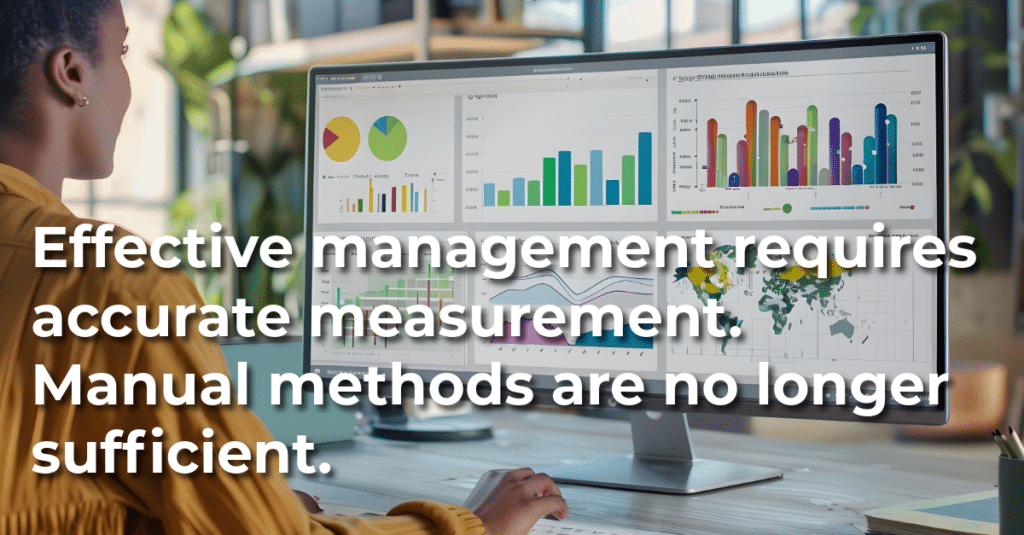
As Brian Van de Water noted in Packaging Impressions last week, metrics are valuable only when they are visual, meaningful, and reviewed frequently enough to drive action. His article is recommended reading.
We would add that most operations struggle with implementation. While the principle is clear, the process is not. Manual measurement methods such as whiteboards, shift logs, and spreadsheets compete with production for attention, and production typically takes priority. As a result, boards become outdated, logs are completed from memory, and by the time data is available, opportunities have already been lost.
Automated data capture eliminates these issues.
CONNECT® is central to this approach. It provides an operator touchscreen at each machine, a real-time dashboard for the production floor, and comprehensive analytics. The system automatically captures uptime, downtime causes, makeready duration, job counts, waste, and consumable usage by device, operator, and shift, without manual data entry. Job-level analysis is immediate, allowing actuals to be compared with estimates in real time rather than reconstructed at month-end.
LYNK™ enables touchless data collection for digital equipment. It is simple, cost-effective, and designed to operate during unattended shifts when no personnel are present to record data.
AUTOMATER™ addresses challenges that many platforms overlook. By integrating sensors, encoders, barcode readers, and PLC protocols, it brings conventional, analog, and legacy machines into the same real-time data environment as newer equipment. Older machines are no longer excluded from operational visibility.
Q™, our AI-powered production intelligence, allows users to analyze production data without specialized expertise. Users can ask questions in plain language and receive immediate answers. Trends and anomalies are identified automatically, without the need to build reports in advance.
The CONNECT API transfers verified shop floor data directly into your MIS or ERP, ensuring that estimating and billing are based on actual events rather than assumptions.
All solutions are vendor-neutral, compatible with equipment from any manufacturer, and can be deployed within days.
Two things follow from that, and the second one matters
First, you can measure what is meaningful rather than what is merely convenient. For example, a machine counter records impressions but cannot determine which were sellable. Metrics such as waste compared to job estimates, true productive availability versus scheduled uptime, and actual cost versus estimate are critical for financial performance, yet manual systems rarely capture them accurately.
Second, you can evaluate personnel performance objectively. This benefit is often overlooked. When performance is subjective, disagreements between managers and supervisors can persist, and genuine improvements may go unrecognized. Objective data resolves these disputes, highlighting both underperformance and achievements. Demonstrable recognition is more valuable than unsubstantiated praise. Operators who can view their performance metrics in real time are more likely to manage and improve their results.
Capture → Monitor → Analyze → Monetize.
This is the complete model, and it does not rely on manual updates.