
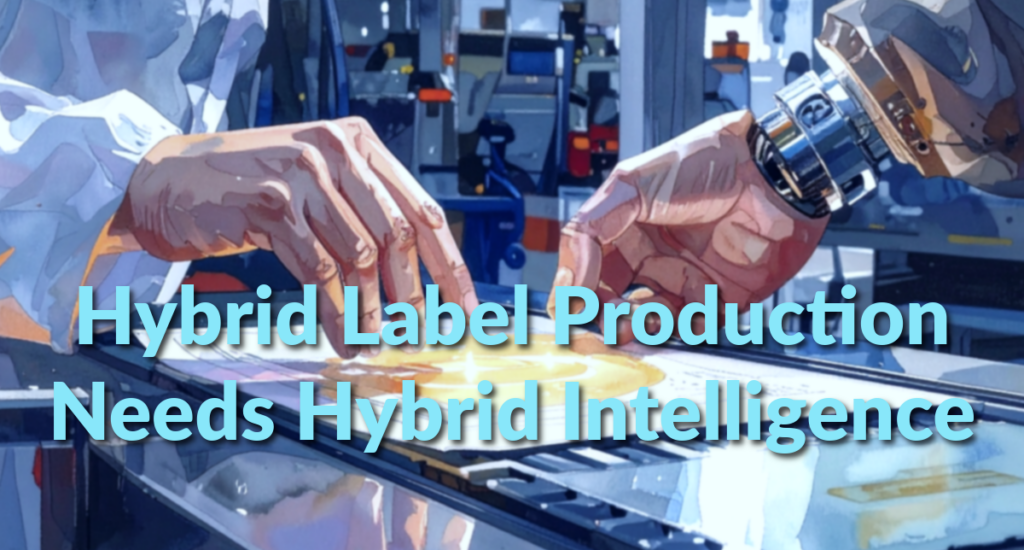
Hybrid production offers converters flexibility, while hybrid intelligence identifies the most profitable option.
Hybrid production is a key topic in label and package printing. At LOUPE Americas, converters can explore digital presses, flexo platforms, hybrid systems, embellishment, finishing, inspection, automation, substrates, and workflow tools that expand production capabilities. The following week, PRINTING United Expo broadens the discussion to include automation, packaging, software, and AI.
The technology is compelling, but the operational impact is even more significant.
A hybrid environment provides converters with multiple options. Jobs may run digitally, via flexo, through hybrid methods, or with a mix of print and offline finishing. This flexibility is valuable because it allows businesses to consistently select the optimal path for each job. Routing decisions often depend on availability, experience, and press speed. These factors are important and become more actionable when supported by comprehensive data.
Selecting the best path involves more than choosing a print engine. Factors such as run length, version count, substrate, ink and coating requirements, embellishment, inspection, die-cutting, finishing, labor, waste, deadlines, and customer expectations all play a role. A job that seems ideal for one device may lose margin due to finishing constraints, while another that appears costly may prove efficient by reducing setup, waste, or handoffs.
Hybrid intelligence provides the data needed to evaluate these trade-offs. It connects performance across devices and processes, enabling fair comparisons and informed decisions based on historical data. It identifies which applications perform best on specific assets and distinguishes press performance from workflow delays, inspection patterns, finishing constraints, and material issues.
This leads to an important shift: planners move from asking where a job can run to knowing where it should run.
This is not about claiming digital is superior to flexo, or that hybrid is better than either. Each technology offers distinct strengths. The goal is to match each job to the appropriate technology, considering the entire production process and relying on data rather than assumptions.
Hybrid intelligence also preserves institutional knowledge. Experienced planners understand which jobs are demanding, which materials present risks, and which assets perform best under specific conditions. This knowledge is valuable but vulnerable if it resides only with individuals. Data transforms operational insights into assets accessible to future planners, supervisors, or estimators.
AI further enhances this value. Determining the optimal path relies on a clean, connected data history. Building this foundation now ensures more accurate answers as tools advance.
Success will not depend solely on having the most technology. It will belong to converters who make every technology choice measurable.
We invite you to visit us at LOUPE Americas, September 15–17, Booth 1421 in Chicago, and at PRINTING United Expo, September 23–25, Booth N6349 in Las Vegas.